The Myth of Competitive Balance
No, really, I promise you don't want MLB to be more like the NFL. Unless you're talking about doing a cool halftime show during the World Series. That could be fun.

I'll start with Reddit's favorite disclaimer: I am not a lawyer (labor or otherwise). Am I at least a sports historian or economist? No. Do you need my take on the topic of "competitive balance" in a time where everyone and their dog is putting out thinkpieces about it? God, no. Am I going to provide it anyway? Yes, absolutely. The often poorly-reasoned discourse around the subject is maddening, and part of this blog's raison d'être is to let me address things I find sufficiently infuriating about baseball, even if other people have already done so.
I'm not arrogant enough to suggest that I have solved every problem with MLB's economic future within the span of this post. It would be ridiculous to even try such a thing, so instead I'm focusing on MLB's rhetoric around labor negotiations—in particular, scrutinizing the rigor of one specific (but significant) argument they've put forth this year. On June 25, MLB's official account posted this tweet about their CBA proposals, highlighting the issue of the salary cap:
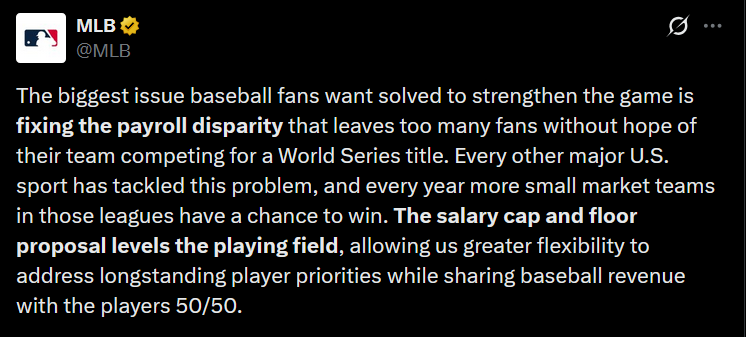
In the span of these three sentences, they present the following claims:
- The primary concern of baseball fans is their team's ability to compete for a World Series title, the biggest obstacle to which is payroll disparity.
- Every other major U.S. sport has addressed the problem of payroll disparity insofar as it hampers championship prospects.
- More small-market teams in other U.S. sports have "a chance to win".
- Implementing a salary cap and floor creates equality of opportunity for all teams, which is what gives small-market teams "a chance to win".
(Bonus argument: they also assert in a reply that "fans overwhelmingly support a salary cap and floor", which, of course, has absolutely zero accompanying evidence upholding it. Before you jump in to tell me that supporting evidence exists, my primary issue is that MLB is not presenting any proof of it, which a (subjective!) claim of that magnitude should require in order to be taken as factual.)
I think it's fair to say that the implied argument that follows from these statements is: "All other major U.S. sports have, through the implementation of a salary cap and floor, successfully created equality of opportunity for all teams to compete for a championship title, which results in a greater diversity of championship winners rather than titles being dominated by the teams in the biggest markets." I think it's also fair to say that is the popular perception of the current problem, or at least the one I see cap advocates espouse most frequently online (which I will not claim as representative of the entire population).
I didn't think that sounded true at all. So, to evaluate whether or not that argument held up, I looked into the distribution of championship titles in the NFL and NBA since the implementation of each league's salary cap system.[1]
Why the championship titles? Well, "a chance to win" is incredibly vague and can be interpreted in any number of ways, but let's set a high bar for simplicity's sake. It seems reasonable to suggest that making it to the final championship round, whether you win or lose, constitutes having "a chance to win"; after all, you have made the playoffs, beaten everyone in your path, and now the only thing standing between you and the title is one other team. I could argue that making the playoffs at all, or advancing to some lower stage, is sufficient as a meaningful chance to win a title (and I do, in fact, believe that). However, I think that most people would agree that, at a minimum, a championship title round appearance constitutes such a chance, even if they don't agree on what else might count. Without further ado, let's get into it.
Case Study: The NFL
If you don't follow football, here's what you need to know about their league structure: there are 32 active teams, split into 2 conferences that each have 4 divisions (3 divisions from 1970–2002). The modern league has existed since the AFL fully merged with the NFL in 1970, with the Super Bowl as its championship game (though it was first played in the 1966 season). 6 teams have been established since the merger, 4 of which were established after the implementation of the salary cap. As with baseball, some franchises have moved to different locations over time; the Cleveland Browns and Baltimore Ravens also have their own weird thing going on, but I'm going to ignore that. From 1990–2019, the playoff structure held 12 teams; that number increased to 14 starting in 2020.
Since the 1994 season, the NFL has operated on a per-team hard cap-and-floor system, which is what most people picture when you bring up the concept of a cap. The only uncapped season in the intervening time was 2010, during which most teams still pretty much spent like they had a cap (per Pro Football Network). For the purposes of my analysis, I opted to include the 2010 season, principally because it would have been annoying to exclude—and that gives us a nice, round number of 32 seasons since the introduction of the cap.
In those 32 seasons, here's how Super Bowl victories have been distributed:[2]
- New England Patriots: 6
- Kansas City Chiefs, Denver Broncos: 3
- St. Louis/Los Angeles Rams, Tampa Bay Buccaneers, Seattle Seahawks, Pittsburgh Steelers, Philadelphia Eagles, New York Giants, Green Bay Packers, Baltimore Ravens: 2
- San Francisco 49ers, New Orleans Saints, Indianapolis Colts, Dallas Cowboys: 1
And here's the breakdown of which teams have lost the Super Bowl in that time frame, since those teams ostensibly had "a chance to win":
- Patriots: 5
- 49ers: 3
- Rams, Seahawks, Steelers, Eagles, Chiefs, Carolina Panthers, Atlanta Falcons: 2
- Giants, Colts, Packers, Broncos, Tennessee Titans, San Diego Chargers, Oakland Raiders, Cincinnati Bengals, Chicago Bears, Arizona Cardinals: 1
In sum: since the NFL implemented a salary cap, 15 different franchises have won the Super Bowl. Another 8 have unsuccessfully contended for the title. 11 of those 32 Super Bowls—more than one-third—have involved the same team: the New England Patriots, who only appeared in the Super Bowl one time prior to the 1994 season, and who subsequently spent about 20 years kicking everyone else's teeth in with the help of Tom Brady. Coincidentally, Boston is a relatively big sports market, and Forbes listed the Patriots as the 7th-most valuable sports team in the world at the end of 2025.
In the full context of NFL history, 12 active teams have never won the Super Bowl—7 of which existed before the Super Bowl was established. 4 teams have never appeared in the Super Bowl, 2 of which (the Lions and Browns) have been around the entire time. The longest championship appearance and win drought belongs to the New York Jets, who have not made it back to the Super Bowl since they won in 1968. The Jets haven't even appeared in the playoffs since 2010.
I could belabor the point a little, so I will. The Buffalo Bills went to, and lost, 4 consecutive Super Bowls immediately before the implementation of the salary cap. They then missed the playoffs for 17 consecutive seasons beginning in 2000, making them the last team in North American pro sports to reach their league's postseason after the turn of the century. Meanwhile, in the 17 seasons spanning the Patriots' first and last wins, New England appeared in 9 Super Bowls and lost 3. They only missed the playoffs twice in that time. Kansas City won 3 Super Bowls and lost another 2 in the span of 6 years.[3] And so on. Got it? Good.
Case Study: The NBA
Like MLB, the NBA has 30 teams, split into 2 conferences with 3 divisions each; unlike MLB, the NBA playoffs have had a 16-team capacity since the 1983–84 season (not including play-in games). Similar to the NFL, the modern league as we know it has existed since the ABA-NBA merger prior to the 1976–77 season, and 8 franchises have been established since the merger (again ignoring the Charlotte Hornets/New Orleans Pelicans weirdness). The NBA Finals themselves date back longer, having first been played (as the BAA Finals) at the end of the 1946–47 season.
The cap system used in the NBA is a convoluted soft cap with explicit limitations on both team payroll and individual player salaries, as well as a luxury tax system like the one present in MLB. The "Bird Rights" provision referred to further down in the MLB tweet is one of many on the laundry list of exceptions that allow teams to circumvent the cap in some way. Due to the cap's soft nature, most teams end up exceeding it. Since it was first implemented in the 1984–85 season, there have been 42 NBA Finals, won by the following teams:
- Los Angeles Lakers: 9
- Chicago Bulls: 6
- San Antonio Spurs: 5
- Golden State Warriors: 4
- Miami Heat, Detroit Pistons, Boston Celtics: 3
- Houston Rockets: 2
- Toronto Raptors, Oklahoma City Thunder, New York Knicks, Milwaukee Bucks, Denver Nuggets, Dallas Mavericks, Cleveland Cavaliers: 1
And here's which teams lost the Finals in that time:[4]
- Heat, Lakers, Cavaliers, Celtics: 4
- Spurs, Knicks, Warriors, Pistons, Mavericks, Thunder/Seattle SuperSonics, Utah Jazz, Portland Trail Blazers, Phoenix Suns, Orlando Magic, New Jersey Nets, Indiana Pacers: 2
- Rockets, Philadelphia 76ers: 1
Anything jump out at you about relative number of appearances? Over the last 42 seasons, 15 different franchises have won the NBA Finals, and another 7 have tried and failed. The Los Angeles Lakers alone have won about 21% of those titles and appeared in just under 31%. I don't know if you've heard, but L.A. is a pretty sizable market; the Lakers happen to be the 2nd-most valuable sports team in the world. (Fun fact: on Spotrac, you can go back year-by-year through the 2011–12 season and sort teams by how much they exceeded the cap. You will find that, in 10 of those 15 seasons, the Finals winner has been in the top 10 biggest spenders.)
In the history of the NBA, 10 franchises have never won the NBA Finals and 5 have never made an appearance at all, the latter of which ties the NHL for the highest number among major U.S. sports; additionally, the Sacramento Kings and Atlanta Hawks haven't appeared in the championships since before the ABA-NBA merger, and have title droughts of 74 and 67 seasons respectively. The Charlotte Hornets and New Orleans Pelicans, both established post-salary cap, have never even made it to the conference finals. In fact, the Hornets haven't made the playoffs in 10 years—in a league where over half the teams make it every season!
How MLB Stacks Up
Generally speaking, I don't consider any sports league in which a single franchise appears in a third of the championship series to have "leveled the playing field", even if some of their past winners come from relatively smaller markets. Based on the reactions to the Patriots, Chiefs, and Lakers I've seen from every football and basketball fan around me, I think baseball fans would actually really fucking hate having what passes for "competitive balance" in other sports. But if championship wins and appearances are so poorly distributed in sports with a salary cap, then it must be even worse in MLB, right?
Here's how many MLB teams have won the World Series since the NFL implemented their salary cap (only 31 seasons due to the 1994 strike):
- New York Yankees: 5
- Boston Red Sox: 4
- Los Angeles Dodgers, San Francisco Giants: 3
- Atlanta Braves, Florida Marlins, Houston Astros, St. Louis Cardinals: 2
- Anaheim Angels, Arizona Diamondbacks, Chicago Cubs, Chicago White Sox, Kansas City Royals, Philadelphia Phillies, Texas Rangers, Washington Nationals: 1
And here's how many have lost:
- Yankees, Astros, Cleveland Indians/Guardians: 3
- Braves, Dodgers, Phillies, Cardinals, Rangers, Detroit Tigers, New York Mets, Tampa Bay Rays: 2
- Diamondbacks, Royals, Giants, Colorado Rockies, San Diego Padres, Toronto Blue Jays: 1
For those keeping score at home, that's 16 teams who have won titles and another 7 who have failed in the attempt. In 31 seasons, 23 out of 30 MLB teams have appeared in a World Series, with no team having appeared more than 8 times. Compare that to the NFL, where 9 teams have yet to appear in a post-cap Super Bowl and one team (in a very big market!) has appeared in over a third of those games.
To match the NBA's cap implementation, let's add the 10 seasons going back to 1984 and see who won:
- Blue Jays, Minnesota Twins: 2
- Tigers, Royals, Dodgers, Mets, Cincinnati Reds, Oakland Athletics: 1
And who lost:
- Braves, Athletics, Cardinals: 2
- Red Sox, Phillies, Padres, Giants: 1
We have 3 additional teams who have appeared in and won the World Series during that time, bringing the total to 19 unique winners and 7 additional losers in 41 seasons. This has all happened in a league where relatively few teams are allowed to make the playoffs:
- 4 teams (out of 24–28) from 1969–93;
- 8 teams (out of 28–30) from 1994–2011;
- 10 teams from 2012–21 (except for the 16-team playoffs of 2020);
- 12 teams since 2022.
During the salary cap era (and really for most of their history), it has been harder for MLB teams to make the postseason than in other sports, solely by the metric of available playoff spots relative to number of teams.[5] Not to mention the fact that an MLB team must win at least 11 games to win the World Series, assuming they have a first-round bye; in the NFL, the most you will ever have to win is 4, assuming you do not have a bye. (The NBA playoffs, by comparison, require more work, since there are no first-round byes and each round is best-of-7.)[6]
My argument hinges principally on the following premise: the only way to demonstrate that there is a level playing field is with that field's outcomes. It's the same way you would conclude that a coin or a die is fair, except that in those cases, you can feasibly conduct thousands of trials (not that it would be a good use of your time). Here, we can only work with the results given to us annually, which constitute a rather small sample size, thus rendering it very difficult to make strong claims in any direction about competitive balance... but this applies to MLB's claims as much as it does mine. If you accept that premise, then the only logical conclusion is this: the NFL and NBA have not had relative equality of outcomes since the implementation of their salary caps, so you cannot prove the level playing field exists, nor can you prove that such a thing would exist specifically due to a salary cap system and no other factors.
It's important to remember that MLB is implicitly furthering the argument that the salary cap system is what created the alleged parity in these sports, while simultaneously conveniently omitting things like how much of the NFL's revenue comes from national broadcast deals and is evenly shared, as well as probably the biggest issue: these are very different sports played in very different ways, resulting in massive differences in terms of roster sizes, league structures, farm systems, season lengths, and more—including the impact of individual players.
Popular perception would suggest that one or two star players can completely alter a franchise's trajectory in the NFL/NBA, and that is arguably not the case in MLB for reasons inherent to the sport. Compare, for example, the Buffalo Bills—whose return to perennial contention began with Josh Allen's first full season as starting quarterback in 2019 and particularly his emergence as a superstar in 2020—and the Los Angeles Angels, who have made the postseason exactly one time during Mike Trout's major-league career, and exactly zero times during the 6-season span in which their roster boasted both Trout and Shohei Ohtani. Much of the team around Allen has changed, but their success has not—as long as he has led them in Pro Football Reference's Approximate Value, they have advanced at minimum to the divisional round of the playoffs. The 2022 Angels got 15.8 bWAR out of Trout and Ohtani alone, and for their troubles, they finished 33 games back of the division lead. That was the only year they placed higher than 4th in the division while Ohtani was there.
But that's all cherry-picked anecdotal evidence. I haven't actually researched the impact of individual players on team outcomes in different sports, so if you know of any existing literature on the subject, I'd love to see it! Regardless of whether individual players actually impact teams differently in baseball versus other sports, however, the other notable differences still stand, and it would be ridiculous to ignore them as factors when evaluating the existence of competitive balance and what external measures might affect it. One of the biggest remaining questions at the foundation of this argument is what constitutes a "small market" to begin with... but that's going to be another post. My goal here was to confront the idea of the "level playing field" in salary-capped sports leagues as MLB has presented it—no more, no less—and that, for now, is complete.
I hope you enjoyed this breakdown! I originally told myself I'd only be addressing the disingenuous implications of that lone MLB tweet, but it quickly became impossible not to pick apart everything else about the salary cap discourse. I also really wanted to get this out sooner rather than later, so the parts of that analysis that didn't end up in here will appear in the next installment.
For more on the CBA, salary cap, competitive balance, and related subjects, I recommend Craig Goldstein's article "MLB’s Labor Philosophy: A Reader’s Guide" as a free-to-read piece over at Baseball Prospectus. If you have access to paywalled Prospectus articles, here's a collection of things that I read at various stages during the process of writing this:
- Rob Mains, "Inequality, Mobility, and Salary Caps: Playoff Mobility" (June 12, 2025)
- Rob Mains, "Inequality, Mobility and Salary Caps: Of Dishwashers and Salary Caps" (June 17, 2025)
- Marc Normandin, "The Owners Deliver Their Opening Arguments" (June 2, 2026)
- Marc Normandin, "MLB is in Search of Competitive Balance Sheets" (June 11, 2026)
- Marc Normandin, "Rob Manfred Has a Draft to Sell You" (June 23, 2026)
- Patrick Dubuque, "Baseball Is Perfect, Baseball Was Doomed from the Start" (June 30, 2026)
- Marc Normandin, "MLB Wants to be the NBA" (July 6, 2026)
- Steven Goldman, "The Dodgers vs. the Pinstriped Padosamas" (July 23, 2026)
- Steven Goldman, "The Bronx Big Spenders in the Time of Cassette Tapes and Constant Disappointment" (August 6, 2026)
- Marc Normandin, "Only in (The) New York(er)" (August 14, 2026)
- Rob Mains, "Why I’m Worried About the 2027 Season—Part 1" (August 24, 2026)
- Rob Mains, "Why I’m Worried About the 2027 Season – Part 2" (August 25, 2026)
- Marc Normandin, "MLB’s Latest Proposal Offers No Forward Progress" (August 28, 2026)
Thank you, as usual, to Sports Reference for their excellent data collection and the Stathead search tool.
I didn't look into the NHL because I don't care, plus they've only had a salary cap for about 20 years, and I think calling soccer a "major sport" here is generous. ↩︎
Some people might want to consider the Rams two different teams that have each won one title for the purposes of comparing market sizes; I am treating them as one franchise that has won two titles, because that's what they are. Same applies to any other franchises that have moved. ↩︎
As one Reddit commenter put it: "Yeah it went from one-off feel good story to perpetual threat to anyone else's team having success." Another commenter coined the term "dominance fatigue": "To roll from a 20 year of no real hope from the Patriots to this." These were posted on February 18, 2024, a week after they won their last Super Bowl. Of course, they immediately went back to the Super Bowl again the next year. ↩︎
For the moment, I am begrudgingly counting Seattle and OKC (with one loss each) as the same franchise, per official NBA records. If Seattle is granted a new team, however, they will most likely inherit the SuperSonics' history. ↩︎
Of course, making the playoffs isn't necessarily equally competitive between different sports, which this framing oversimplifies. If you're interested in a bit more analysis on how hard it is to make the postseason in reality, Rob Mains did some very cool work on MLB playoff mobility in this article last year. ↩︎
Don't even get me started on the tomfoolery going on over in the NHL, by the way; they've had 16-team playoffs since they only had 21 teams in the league, and they only hit 32 teams in 2021. ↩︎